First reported in 2025, Fire Ant remained active into 2026. Explore how the threat actor expanded beyond hypervisors into trusted infrastructure, compromising routers, authentication systems, and Linux management hosts to maintain covert access, collect credentials and traffic, and reach connected high-value environments.
First reported in 2025, Fire Ant remained active into 2026, expanding from hypervisor-level compromise into the trusted infrastructure layer that routes, authenticates, connects, and manages high-value environments.
The compromise impacted both the direct and third-party environments. Its trusted infrastructure relationships created potential reachability into connected external environments, including high-value networks and critical infrastructure. Fire Ant appeared to use this trusted position to explore access paths beyond the initially compromised environment. Compromised routers became operational platforms. Fire Ant used router infrastructure for covert connectivity, traffic collection, command-output manipulation, and suppression of logging.
Fire Ant targeted authentication chokepoints. The actor compromised TACACS infrastructure to intercept authentication flows, collect credentials, and weaken confidence in administrative audit trails.
Fire Ant built a resilient access layer. The actor deployed long-lived implants across Linux management infrastructure, including Medusa-related components, custom SSH backdoors, Zabbix-masquerading malware, and packet-triggered backdoors.
Fire Ant manipulated the evidence layer itself. Across routers, TACACS servers, and Linux hosts, the actor modified or bypassed telemetry sources defenders normally rely on, reinforcing the need to validate logs against memory, disk, network, authentication, and configuration evidence.
Fire Ant, first reported in 2025, remained active in 2026 and expanded its operations beyond hypervisors into the trusted infrastructure that routes traffic, authenticates administrators, manages access, and records activity. The main finding is that the actor was no longer targeting only individual systems, it was targeting the infrastructure layer that controls how entire environments connect and operate both within and across organizational boundaries.
This created a “target behind the target” risk. By compromising routers, authentication systems, and Linux management hosts, Fire Ant gained strategic positions from which it could collect traffic and credentials, maintain covert access, and explore paths toward connected high-value environments, including critical infrastructure. The compromise therefore had implications beyond the systems directly affected.
The actor also manipulated the evidence sources defenders depend on. It suppressed router logging, altered command output, captured administrative credentials, tampered with host logs, and deployed multiple persistent backdoors. As a result, investigators could not rely on any single source of telemetry to accurately reconstruct the activity.
The key implication for organizations is that routers, authentication servers, hypervisors, jump hosts, and management appliances must be treated as first-class security and forensic assets. These systems require the same level of monitoring, hardening, and incident-response readiness as traditional endpoints and servers. When trusted infrastructure is compromised, an attacker can gain both a path into connected environments and the ability to obscure how that access was used.
Fire Ant’s earlier activity showed that hypervisors can be more than platforms that host workloads. In the hands of an advanced actor, they can become privileged vantage points from which to reach guest systems, bypass segmentation and operate under the line of sight of many endpoint controls.
The 2026 activity expands this same principle to network and management infrastructure. The actor did not only pursue servers and workstations. It targeted systems that other systems depend on: edge routers, TACACS servers, Linux jump hosts and virtualized management servers. These are the systems that decide who can reach what, which credentials are trusted and which logs exist after the fact.
This is the continuity from 2025 to 2026. The technology changed, but the strategy remained consistent: operate from layers that are trusted, privileged and difficult to inspect.
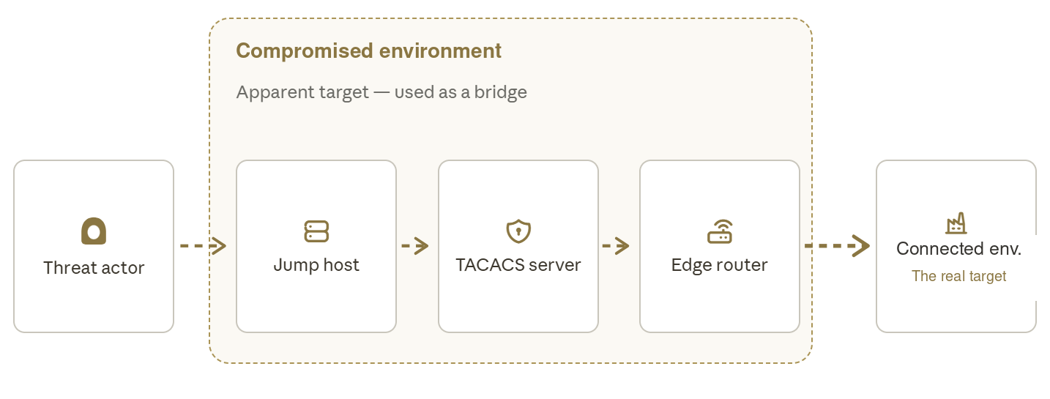
Highly interconnected environments are strategically valuable because they sit between systems and network zones. They provide routing, managed connectivity, authentication paths, and operational access across connected networks. A compromised infrastructure layer can become a bridge to other environments.
This is the key difference from prior Fire Ant activity. The actor appeared to use the compromised environment as an infrastructure platform from which it could explore reachability into connected high-value networks, including critical infrastructure. In this model, routers, TACACS servers and jump hosts are not peripheral assets. They are the path to the target behind the target.
For defenders, this distinction matters. If the investigation focuses only on the initially compromised systems, it may miss the broader operational objective. If the investigation treats the network and management infrastructure as a trusted connectivity layer, the scope expands to connected routes, administrative paths, shared authentication infrastructure and the systems that control segmentation.
Figure 1: The compromised environment as a bridge into connected targets.
Fire Ant’s activity demonstrated that edge routers should not be treated as passive network infrastructure. In this intrusion, the actor gained access to Cisco IOS XR routers and turned them into operational platforms capable of supporting stealth, persistence, and potential reach into connected environments.
The investigation began with an anomaly that appeared, at first, to be a configuration inconsistency: a tunnel interface became operational on a Cisco IOS XR router even though no corresponding running configuration or commit history could explain its creation. The interface was associated with a specific VRF and used GRE encapsulation, but standard configuration review did not provide a reliable explanation for how it appeared. This discrepancy became a key investigative lead because it suggested that the device’s operational state could no longer be trusted to match the configuration and audit records visible to administrators.
Fire Ant’s router compromise was not built around generic Linux tooling. The malware recovered from the compromised Cisco IOS XR environment was purpose-built for the router control plane, with components that interacted directly with IOS XR logging, command execution, routing, VRF resolution, AAA, and Telnet-management functions. This distinction is important: Fire Ant was not simply running malware on a Linux-based appliance; it was modifying the systems that make the router manageable and trustworthy.
The toolkit included a boot-themed persistence script on /etc/rc.d/init.d/grub-rommon masquerading as a legitimate service.

Figure 2: Masqueraded grub-common service used to monitor and launch the acpid implant. This script monitored and launched the acpid implant from /usr/bin/acpid, using an hourly schedule that started the implant during odd-numbered hours and stopped it during even-numbered hours. The design suggests an attempt to maintain access while reducing continuous process visibility during routine inspection.


Figure 3: The persistence script starts acpid only during odd-numbered hours and stops it during The acpid component embedded a modified IOS XR syslog library. In the modified evsyslog flow, log delivery was routed through a custom wrapper that checked for the string “Health” before calling mq_send. When the condition was not met, the wrapper returned a success-like value without forwarding the message, indicating selective manipulation of router log delivery.


Figure 4: Modified IOS XR syslog flow in acpid: log delivery is routed through sub_7000, which conditionally forwards messages to mg_send based on the presence of “Health”. The acpid component also contained shell-related indicators, including references to pseudo-terminal paths, interactive connection banners, escape-sequence handling, and a command to unset shell-history environment variables. It indicates that acpid likely supported interactive access or shell staging in addition to its telemetry-manipulation role.

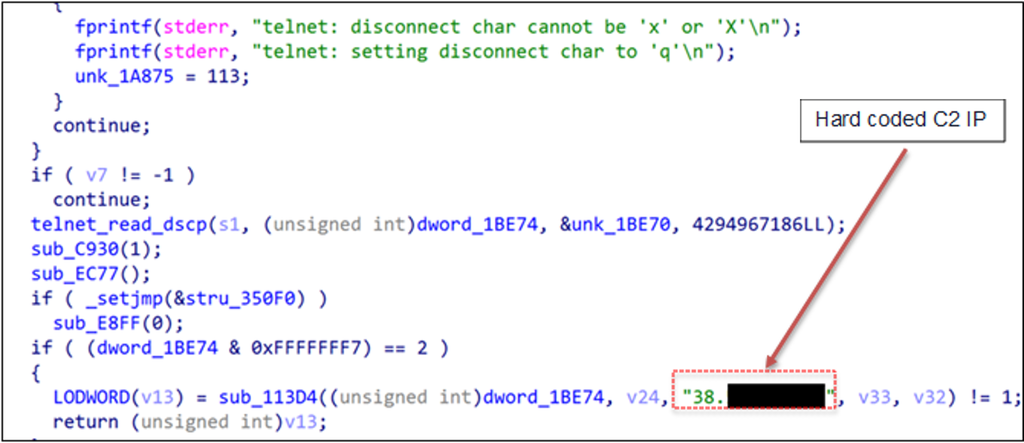
Taken together, these components show that Fire Ant treated routers as operational platforms. The actor built capabilities for persistence, outbound communication, syslog suppression, and command-output manipulation. In a highly interconnected environment, this level of router control is strategically significant: a compromised edge router can become a vantage point for covert connectivity, traffic observation, and access to connected networks, including critical infrastructure environments that rely on trusted routing and management paths.
The tunnel anomaly also shifted the investigation from the compromised router itself to the infrastructure it appeared to connect with. Once Fire Ant demonstrated the ability to manipulate the router’s configuration view, suppress telemetry, and potentially conceal operational state, the key question was no longer only how the tunnel was created, but where it led and what role the other side played in the operation. Tracing the far end of the GRE tunnel exposed another part of the actor’s infrastructure: a legacy Linux system.
Activity on the Linux system showed that the GRE tunnel was not only an anomalous configuration artifact; it was also an operational path. From this host, Fire Ant conducted repeated connection attempts and port probing toward connected high-value environments, including systems associated with critical infrastructure. The observed activity included attempts against common administrative and service ports such as SSH, HTTP/HTTPS, SMB/RPC-related ports and RDP. This indicates that the actor used the tunnel to extend reach beyond the compromised router and into environments reachable through the compromised network infrastructure.

Sygnia tracks this Zabbix-masquerading implant as BridgeAgent, reflecting its role on the GRE-connected Linux host as a bridge for actor-controlled access into connected environments.
BridgeAgent is configured for persistence through a zabbix_agent.service systemd unit, set to run as root with automatic restart behavior. Once executed, BridgeAgent changed its apparent command line to resemble /usr/bin/gnome-shell, loaded encrypted configuration from /opt/.ICEauthority, and performed periodic HTTPS polling to retrieve controller-supplied configuration.


After establishing access to router infrastructure, Fire Ant used the network layer as an intelligence source. The actor was observed capturing traffic from multiple Cisco routers and uploading the resulting PCAP files to external FTP infrastructure. This behavior shifts the router’s role from a transit device to a collection platform. once the actor controlled the router, the device became a vantage point for observing traffic moving through trusted network paths.

Router-based PCAP collection is especially valuable for infrastructure-focused actors. Packet captures from routers can expose internal topology, management connections, authentication flows, routing relationships, and traffic patterns between connected environments. Unlike endpoint collection, which gives visibility into a single host, router collection can provide a broader view of how systems, administrators, and connected networks interact.
The timing and preparation of the external FTP infrastructure also stood out. One of the FTP services used for the uploads appeared to have been installed on the same day the router PCAP upload activity occurred, suggesting that the actor prepared external collection infrastructure close to the operational window.
Additional router commands observed around the same administrative activity included access to command-history-related paths and traceroute activity toward unusual external domains. The pattern is consistent with an actor using routers for both collection and network reconnaissance.
This activity reinforces one of the core observations from the investigation: when a threat actor controls routers, they do not only gain reach. They gain perspective. Fire Ant used network infrastructure to observe the environment from the inside, collecting information that could support lateral movement, credential targeting, and cross-network access planning.
Fire Ant’s activity extended beyond the routers themselves into the systems used to authenticate and record administrative access to them. This is a critical distinction: the actor was not only abusing valid credentials but also targeting the infrastructure responsible for validating those credentials and preserving the audit trail.
On the TACACS server, investigators identified a VMCI-socket-based backdoor deployed under /var/tmp/audit. The backdoor supported communication over VMware VSOCK/VMCI interfaces, providing an access path that would not necessarily appear as a normal network login to the guest operating system. This finding connected the TACACS compromise back to Fire Ant’s broader pattern of abusing virtualization-adjacent access paths.

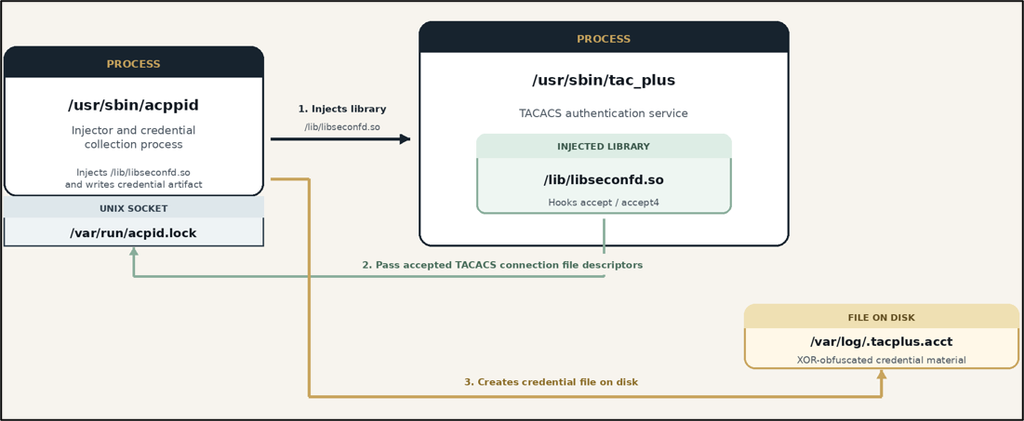
The investigation also identified a malicious binary, /usr/sbin/acppid. Sygnia tracks this TACACS credential-collection toolset as TacTap. TacTap should be understood as a multi-component mechanism rather than a single binary: /usr/sbin/acppid acted as the injector and collection process, while /lib/libseconfd.so operated inside the tac_plus process. Together, the components enabled library injection, accepted-session interception, Unix-socket file-descriptor handoff through /var/run/acpid.lock, and creation of the XOR-obfuscated credential artifact at /var/log/.tacplus.acct
Reverse engineering of acppid showed that the binary was designed to maintain a malicious shared object inside the TACACS daemon. The original IDA view shows that acppid retrieves optional runtime configuration from the TARGET_PROG and SO_PATH environment variables. If those values are not provided, it defaults to targeting the tac_plus process and using /lib/libseconfd.so as the shared object path.


The injected library, libseconfd.so, was designed to operate inside the TACACS process. Reverse engineering showed that it hooked accept and accept4, placing the implant inside the TACACS session-handling path. This allowed the malicious code to interact with newly accepted TACACS client connections from within the service process itself.
The hook then forwarded accepted connection file descriptors to acppid through a local UNIX socket at /var/run/acpid.lock, using sendmsg-style file-descriptor passing. This design allowed one malicious component inside the TACACS process to hand live connection handles to another process, enabling the actor to observe or process TACACS session material from within the authentication flow.


The lesson is clear: when the authentication layer is compromised, defenders can no longer ask only “which account performed the action? They must also ask whether the system recording that action can still be trusted.
Fire Ant did not rely on a single foothold. Across Linux management infrastructure, the actor built a durable access layer using Medusa-rootkit, custom SSH backdoors, masqueraded binaries, credential capture, and host-level configuration changes. The objective was not only to compromise Linux hosts, but to convert them into reusable operational infrastructure.
A key feature of this access layer was its duration. Several Linux access components were deployed in 2025 and remained available into 2026, when Fire Ant was later observed using them for hands-on activity. This shows that the actor treated Linux management hosts as long-lived staging and access nodes, not temporary footholds.
The long-lived nature of this access layer was visible in the Linux bodyfile timeline. Several Medusa-rootkit-related and custom SSH backdoor artifacts were created in 2025, including files under /usr/lib/locate and binaries such as /usr/sbin/cupsdd and /usr/sbin/smartdd. These artifacts remained relevant into 2026, when Fire Ant later launched hands-on activity through the same access layer

One example of this reuse was the custom SSH backdoor /usr/sbin/cupsdd. The process tree below reflects 2026 operator activity launched through the prepositioned access layer, rather than initial deployment. Through cupsdd, Fire Ant staged and executed additional tooling from /var/tmp, including client and se.py, to support reverse-shell and tunneling activity. Because this access path operated outside the normal SSH service flow, it likely reduced the forensic footprint expected from a conventional SSH session.


Even after the executable was removed from disk, the process remained active in memory. This demonstrates how Fire Ant combined trusted naming, timestamp manipulation, and deleted-but-running execution to hinder defender analysis and reduce the value of disk-only triage.


The binary showed strong functional and code-level overlap with REPTILE-style tooling publicly associated with UNC3886. Similar to REPTILE, it created a raw Layer-2 packet socket, parsed received packets directly, and searched for magic strings before activating. Notably, the sample reused the “hpaVAj2FJ“ kill marker, which has been publicly documented as a REPTILE kill marker. However, the sample was not identical to the previously reported REPTILE implementation: its primary activation marker was “sxcdewqaz!@#” rather than “mznCvqSBo”, and its packet-decoding logic differed from the date-derived XOR routine described in earlier reporting.
The ping binary also showed operational linkage to the earlier se.py activity through the same magic string, “sxcdewqaz!@#”, which was observed in the actor’s connect-back workflow. This suggests that the actor reused a common activation or session-control marker across multiple access components, while adapting the underlying implementation and filenames.
Analysis showed that the malware is a raw packet triggered remote-access controller, that listens on the network interface for TCP packets destined for ports 443, 541, 8443, or 10443, and UDP packets sent from source port 40443 and destination port 500. The malware looks for network packets with two magic strings within the packet.
sxcdewqaz!@# -> Start of packet
hpaVAj2FJ-> End of packet/kill marker of the listener child process

TCP destination ports 443, 541, 8443, and 10443
UDP source port 40443 to destination
port 500
0x9DFB is decimal 40443


The malware creates a PTY pair; the master side is for controlling process to send and receive data while an interactive shell is attached to the slave side. By setting the HISTFILE value to null, the bash history logging is disabled. Hence, the commands executed by the threat actor could not be seen from the .bash_history file. However, analysts can rely on other log sources such as journal log and EDR telemetry.


Across the observed activity, Fire Ant repeatedly targeted the reliability of telemetry itself. The actor did not just seek to remain unseen. It modified, bypassed or removed the systems defenders normally use to reconstruct an intrusion.
On network devices, the actor manipulated the evidence layer by hiding logs, hiding commit activity, suppressing AAA requests, suppressing SNMP traps and filtering command output. On Linux systems, the actor deleted files after execution, left processes running from deleted paths, disabled SELinux, tampered with logs and modified firewall rules. On access appliances and management paths, incomplete command and authentication telemetry created ambiguity around how specific SSH sessions were established.
The result is a fundamental investigative problem: the environment may contain evidence, but the evidence sources may no longer be fully reliable. For this class of actor, defenders cannot simply collect logs and assume they represent ground truth. They must validate logs against memory, disk, network telemetry, authentication records, configuration state, and independent external observations.
Fire Ant anti-forensic activity on the Linux management hosts was selective. The actor replaced the Cisco router’s IP address with an internal IP address within three authentication artifacts, /var/log/wtmp, /var/log/utmp and /var/log/btmp.


Fire Ant’s activity should be understood in the broader context of infrastructure-focused espionage tradecraft. Public reporting from Mandiant and Google Cloud describes UNC3886 as a China-nexus espionage cluster with a sustained focus on virtualization platforms, edge devices and network infrastructure. Sygnia assesses that Fire Ant activity strongly overlaps with this public reporting.
The overlap is strongest at the level of durable behavior. Public reporting has described VMCI-based backdoors, TACACS credential theft, Medusa-rootkit usage, custom SSH access, and router-focused operations. Sygnia’s 2026 observations contain the same operational themes: virtualization-adjacent access, credential capture from authentication infrastructure, Linux rootkits, custom SSH backdoors, router compromise, and deliberate telemetry suppression.
The differences are also important. Several filenames, paths and deployment details differ from public reporting. This should not be treated as a contradiction. For mature actors, atomic indicators often change after exposure, while the operating model remains stable. In this case, the stronger correlation comes from how the actor uses infrastructure, not from whether every path or filename matches a previous report.
The new intelligence value from Sygnia’s observations extends the model into a highly interconnected environment where routers, TACACS servers and Linux management hosts were used as part of a broader access and collection layer. This reinforces the view that Fire Ant/UNC3886-like operations are not endpoint-centric campaigns. They are infrastructure-control-plane campaigns.
From a threat intelligence perspective, this also clarifies the likely objective behind the activity. In a highly interconnected environment, routers, TACACS servers, virtualization platforms, and Linux management hosts are not only internal systems; they are part of the trusted infrastructure layer that connects, authenticates, and manages access across connected networks. Compromising this layer can provide an actor with more than just persistence inside the immediate victim. It can create a bridge toward other high-value environments, including critical infrastructure that depends on trusted routing, authentication and management relationships.
This reinforces the “target behind the target” concept introduced earlier in this report. Fire Ant’s interest in the compromised organization should be understood not only as an attempt to compromise a single environment, but as an effort to control infrastructure that may enable visibility, collection, and potential access beyond the immediate victim. The strategic value lies in the trust relationships the organization maintains with connected environments.
The findings can be summarized as a four-part operating model. Fire Ant first seeks control over infrastructure systems, then uses those systems to collect intelligence and credentials, builds durable access, and conceals activity by manipulating the evidence layer.
This model is useful because it moves defenders beyond isolated IOCs. A single filename may change. A path may vary. A hash may disappear after remediation. The actor’s operational requirements, however, remain consistent: reach privileged infrastructure, understand routes and trust relationships, harvest credentials, maintain covert access, and weaken the reliability of telemetry.
|
Phase |
What Fire Ant does |
Defender implication |
|
Control |
Compromises routers, hypervisors, TACACS servers, jump hosts and access appliances. |
Scope must include infrastructure that controls reachability, not only business workloads. |
|
Collect |
Captures traffic, extracts credentials and enumerates routes, users, histories and access paths. |
Collection may look like administration or troubleshooting unless correlated across systems. |
|
Build access |
Deploys rootkits, custom SSH, masqueraded binaries, VMCI backdoors and scheduled persistence. |
Remediation must assume multiple access paths and credential reuse. |
|
Conceal |
Suppresses logs, AAA, SNMP, command output, process artifacts and file evidence. |
Investigations must validate telemetry through independent evidence sources. |
Figure 35: Fire Ant operating model and defender implications.
Fire Ant’s recent activity shows that mature espionage actors are no longer focused only on endpoints, servers, or cloud workloads. They are increasingly targeting the infrastructure that sits between environments: routers, hypervisors, TACACS servers, access appliances, Linux management hosts, and the systems that create trust, reachability, and visibility.
In this campaign, the compromised environment was not only a victim. By compromising infrastructure that routes traffic, authenticates administrators, manages access, and records activity, Fire Ant turned the environment into a potential access path toward connected high-value networks, including critical infrastructure. This position allowed the actor to explore reachability beyond the initially compromised environment while also weakening the evidence sources defenders rely on to understand what happened.
The central lesson is that defenders must protect more than the systems that store sensitive data. They must protect the infrastructure that makes other systems reachable, trusted, and observable. When that layer is compromised, the impact extends beyond a single organization: the actor may gain a vantage point for collection, a path toward connected targets, and the ability to make trusted infrastructure tell an incomplete story.
Hunting Fire Ant requires defenders to prioritize behaviors and asset roles over atomic indicators. The most important question is not simply whether a known file exists. It is whether infrastructure systems are exhibiting behavior consistent with control-plane abuse, credential capture, collection or evidence manipulation.
The following hunting guidance is organized around the systems most relevant to the actor’s operating model.
|
Asset class |
High-signal hunting leads |
|
Network devices |
• Unexpected GRE or
tunnel interfaces |
|
TACACS / AAA servers |
• Tac_plus process
injection |
|
Linux jump hosts and management servers |
• Selinux disabling |
|
Security-agent masquerading |
• Unexpected binaries
under security-agent directories |
|
Tunneling and scanning activity |
• Repeated /var/log/secure
entries containing sshd: error: connect_to … port … failed |
|
Linux log and login-record tampering |
• Use of utmpdump against
/var/log/wtmp, /var/log/utmp, or /var/log/btmp |
Figure 36: Fire Ant threat hunting and detection opportunities
The following indicators are selected for defensive use and have been sanitized to remove victim-specific identifiers. Organizations should treat them as starting points for hunting rather than as complete detection logic.
|
filename |
SHA1 |
Role/Description |
|
/bin/atd |
C164BFC953C66E58B11FC280E69FD43B8F255839 |
Custom SSH backdoor |
|
/bin/gdm |
— |
Medusa-rootkit-related component |
|
/usr/sbin/cupsdd |
1aa6ab2006b5d9199aa87bb0bbd995aec698ac4f |
Custom SSH backdoor. |
|
/usr/sbin/smartdd |
c164bfc953c66e58b11fc280e69fd43b8f255839 |
Medusa rootkit binary. |
|
/opt/cybereason/sensor/bin/cybereason-agent/cybereason-agent |
— |
REPTILE like binary renamed to masquerade as Cybereason agent. |
|
/opt/sentinelone/bin/sentinel-agent/sentinel-agent |
— |
REPTILE like binary renamed to masquerade as SentinelOne agent. |
|
/usr/lib/locate |
— |
Medusa rootkit working directory. |
|
/usr/lib/locate/.backup_ld.so |
— |
Medusa rootkit-related file. |
|
/usr/lib/locate/.l |
— |
Medusa rootkit-related file. |
|
/usr/lib/locate/.pd |
— |
Medusa rootkit-related file. |
|
/usr/lib/locate/.pts |
— |
Medusa rootkit-related file. |
|
/usr/lib/locate/boot.sh |
— |
Cusotm SSH backdoor and Medusa-rootkit startup script |
|
/usr/lib/locate/libdl.so |
— |
Hijacked shared object associated with Medusa rootkit. |
|
/usr/lib/locate/local.txt |
— |
Medusa rootkit-related file. |
|
/var/log/remote.txt |
— |
Credential log associated with Medusa-rootkit activity. |
|
/usr/sbin/acppid |
36005f5e4398a1c62a2a9271eddfcc1b44b1ad00 |
TacTap -Injector targeting tac_plus; injects /lib/libseconfd.so and listens on /var/run/acpid.lock. |
|
/lib/libseconfd.so |
955cd45a2f6f226a2fdf44b329af1c8dde90cb38 |
TacTap – Injected TACACS library loaded into tac_plus; intercepts accepted TACACS sessions and sends descriptors to /var/run/acpid.lock. |
|
/var/log/.tacplus.acct |
— |
TacTap – XOR-obfuscated TACACS credential artifact |
|
/var/run/acpid.lock |
— |
TacTap – Unix socket used by acppid to receive accepted TACACS connection file descriptors. |
|
/var/tmp/.bashrc |
— |
Threat actor shell initialization file used with bash rcfile execution. |
|
/var/tmp/audit |
13f0c2a598e3aa63856c032a96b110aed963f0e8 |
VMCI/VSOCK-based backdoor providing shell access through virtualization-adjacent channel. |
|
/var/tmp/esv3X |
— |
Archive |
|
/var/tmp/hourglass-cn |
— |
Threat actor-run script. |
|
/var/tmp/ping |
5ba1242050b5b447052b210788a5a25593d6987d |
REPTILE like binary later renamed to masquerade as security agent processes. |
|
/var/tmp/sync |
7dab017f14628345d47bd4eb69cc49224f3054a7 |
Tineyshell |
|
/var/tmp/tacacs.pcap |
— |
TACACS packet capture artifact created by Fire Ant |
|
/var/tmp/ttt.tar |
— |
Threat actor-created archive. |
|
/var/tmp/u6.py |
— |
Threat actor-created Python script. |
|
a.zip |
— |
Threat actor-created archive. |
|
cli.tar |
— |
Threat actor-created archive. |
|
client |
— |
Malicious client component executed by the threat actor. |
|
se.py |
— |
Threat actor script used for reverse connection / pivoting activity. |
|
ttt.zip.enc |
— |
Threat actor-created archive. |
|
/usr/bin/acpid |
be6b27f429324a4af05a310d8ec9635e37c68a94 |
IOS XR implant |
|
/pkg/bin/dhcpd_show_issu_status |
1682b652a15bde732489f22809b0b7594c228fd3 |
IOS XR implant |
|
/pkg/bin/hd |
b149fa3a34bd585e7a674a4fd9538437bd06f514 |
IOS XR implant |
|
/etc/rc.d/init.d/grub-rommon |
6ef7d2985edf743ebff413a9298a127e9475d72f |
Masqueraded startup script used for persistence |
rule FIREANT_BridgeAgent_Backdoor
{
    meta:
        description = "Detects Fire Ant BridgeAgent Linux backdoor"
        author = "Sygnia"
        sha256 = "110e6fb23be00d2ed251a445ee5b65aadf23b48b8db7419900d64539ad90c5a3"

    strings:
        $s1 = "[+] ########## GetRemoteCfg ##########" ascii
        $s2 = "[+] ########## ParseJson ##########" ascii
        $s3 = "[+] reverse_shell..." ascii
        $s4 = "If you want me to fake your argv, you need to call the program with a longer name." ascii
        $s5 = "/message/" ascii
        $s6 = "thread: running timeout" ascii
        $s7 = "fMDJLBukHuXgtFsCW68o5Zs1qGf" ascii
        $s8 = "2y7b4BSVukszyZz2vuZMppaA4" ascii
        $aes_key = { 07 FA AA 79 67 F1 3F 26 22 8F 5E 9A C9 0B F1 54 }

    condition:
        uint32(0) == 0x464C457F and
        5 of ($s*) and
        $aes_key
}

rule FIREANT_BridgeAgent_Systemd_Unit
{
    meta:
        description = "Detects the companion systemd service from the analyzed sample"
        author = "Sygnia analysis"
        sha256 = "251c7a2684542c29ae2c1e1282b780163bf9f844179ef0759094b2b7e2f62f0f"

    strings:
        $a = "Description=Service for zabbix hosted on PVE" ascii
        $b = "Type=forking" ascii
        $c = "ExecStart=/usr/sbin/zabbix_agent 60" ascii
        $d = "Restart=always" ascii
        $e = "User=root" ascii

    condition:
        all of them
}
rule FIREANT_TACTAP_LIBSECONFD_1 {
    meta:
        author = "Sygnia"
        description = "Detects TacTap injected TACACS library component"
        family = "TacTap"
        component = "libseconfd.so"
        sha1 = "955cd45a2f6f226a2fdf44b329af1c8dde90cb38"
    strings:
        $lib_name = "libseconfd.so" ascii
        $old_accept = "old_accept" ascii
        $old_accept4 = "old_accept4" ascii
        $lib_main = "_lib_main" ascii
        $accept_filter = "accept_filter" ascii
        $accept4_filter = "accept4_filter" ascii
        $plthook1 = "plthook_open_by_address" ascii
        $plthook2 = "plthook_replace" ascii
        $sendmsg = "sendmsg" ascii
        $proc_maps = "/proc/self/maps" ascii

        $acpid_lock_stack = {
            48 BE 2F 76 61 72 2F 72 75 6E
            48 89 30
            48 B9 2F 61 63 70 69 64 2E 6C
            48 89 48 08
            C7 40 10 6F 63 6B 00
        }

    condition:
        uint32(0) == 0x464c457f and
        uint8(4) == 2 and
        uint8(5) == 1 and
        uint16(16) == 3 and
        uint16(18) == 0x3e and
        filesize < 64KB and
        all of them
}
rule FIREANT_TACTAP_ACPPID_1 {
    meta:
        author = "Sygnia"
        description = "Detects TacTap acppid TACACS injector component"
        family = "TacTap"
        component = "acppid"
        sha1 = "36005f5e4398a1c62a2a9271eddfcc1b44b1ad00"

    strings:
        $target_prog = "TARGET_PROG" ascii
        $so_path_env = "SO_PATH" ascii
        $target_proc = "tac_plus" ascii
        $so_path = "/lib/libseconfd.so" ascii
        $socket_path = "/var/run/acpid.lock" ascii
        $proc_maps = "/proc/%s/maps" ascii
        $proc_comm = "/proc/%s/comm" ascii
        $dlopen = "__libc_dlopen_mode" ascii
        $attach_err = "waitpid error while attaching: %s" ascii

    condition:
        uint32(0) == 0x464c457f and
        uint8(4) == 2 and
        uint8(5) == 1 and
        uint16(16) == 2 and
        uint16(18) == 0x3e and
        all of them and
        @target_prog < @so_path_env and
        @so_path_env < @target_proc and
        @target_proc < @so_path and
        (@so_path - @target_prog) < 0x100
}